





| Place of Origin: | China |
|---|---|
| Brand Name: | TMTECK |
| Certification: | CE、ISO9001 |
| Model Number: | TMPA610/ TMPA610TD |
| Minimum Order Quantity: | 1 |
| Price: | Negotiation |
| Packaging Details: | Carton |
| Delivery Time: | 5-8 work days |
| Payment Terms: | T/T |
| Supply Ability: | 50 pieces within one month |
| Name: | Phased Array Flaw Detector | Display: | 11-inch 800X600 TFT Color Display |
|---|---|---|---|
| Dimension: | 284mm×202mm×95mm | Ingress Protection: | IP54 |
| Warranty: | 2 Years | Service: | OEM, ODM, OBM |
| Highlight: | Customized Size Phased Array Flaw Detector,64-Channel Phased Array Ultrasonic Flaw Detector,IP54 Phased Array Flaw Detector |
||
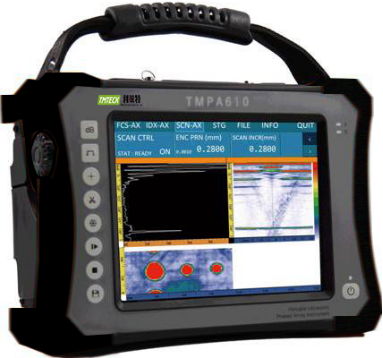
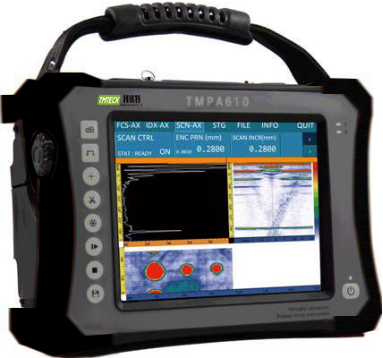
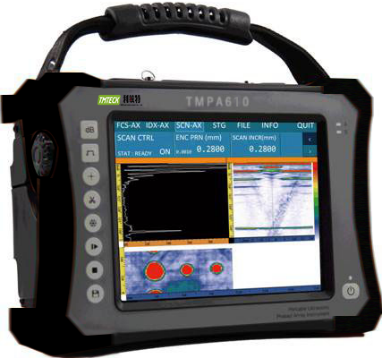
TMPA610 & TMPA610TD — Portable Phased Array Ultrasonic Flaw Detector
The TMPA610 series is a portable 64-channel phased array ultrasonic flaw detector originally developed by TMTECK. It is water- and oil-proof, fan-free, and equipped with a touch screen. With whole-process data logging, innovative phased array probes, and advanced inspection methods, this model delivers superior performance and support — making it one of the best in its class for high cost-to-performance ratio, integrating UT, PA, and TOFD functions in a single unit.
The 3D simulation scheme can be customized to offer one-for-all solutions.
The software menu is presented in an APP-style layout and can be reduced or enlarged according to user requirements.
A metallic housing strengthens the instrument while providing both shielding and heat dissipation.
The protective pedestal prevents damage to either the instrument or the object under inspection.
| Mode | TMPA610 | UT | TMPA610TD |
|---|---|---|---|
| Channel | 16:64 | 2 | 2 |
| Display | 11-inch 800*600 TFT color display |
| Transducer Ports | I-PEX 160-pin PA transducer port; Lemo-00 conventional transducer port, for either T-R or T&R |
| I/O Ports | USB 2.0 port: 2 (qty); HDMI; encoder; LAN (Gigabit-NIC); WIFI; I/O (commissioning); 2D encoder |
| Memory | In-built: 16 GB RAM + 4 GB FLASH; SD card (max 32 GB); External: USB drive |
| Weight | 3.5 kg (with 1 battery) |
| Dimension | 284 mm * 202 mm * 95 mm |
| Power Supply | AC: 100–240 V, 50–60 Hz; DC: 12 V |
| Charging | Battery charging within the instrument or individually |
| Battery Life | 6 hours |
| Working Power | 26 W |
| Language | English |
| Temperature Conditions | Ambiance: -20 °C to 50 °C; Storage: -20 °C to 60 °C |
| IP Rating | 54 |
| Mode | TMPA610 | UT | TMPA610TD |
|---|---|---|---|
| PRF | 50 Hz–10 kHz | 50 Hz–10 kHz | 50 Hz–10 kHz |
| Voltage | Bipolar, ±45 to ±100 V, with 5 V per step | Negative square wave, -75 V to -250 V, with 25 V per step | Negative square wave, -75 V to -250 V, with 25 V per step |
| Pulse Width | 20 ns–800 ns, with 5 ns per step | 20–800 ns, with 5 ns per step | 20–800 ns, with 5 ns per step |
| Damping | 50 Ω | 80 Ω / 400 Ω | 80 Ω / 400 Ω |
| Sampling Rate | 125 MHz | 200 MHz | 200 MHz |
| Delay PRN | 2.5 ns | N/A | N/A |
| Rx Delay | 0–40 µs | N/A | N/A |
| Bandwidth | 0.5 MHz–19 MHz | 0.5 MHz–15 MHz | 0.5 MHz–15 MHz |
| Gain | 0.0–80 dB | 0.0–110.0 dB | 0.0–110.0 dB |
| Filter | 0.5–9.6 MHz; 2.5–12.9 MHz; 3.8–19 MHz; optional | Broadband, narrowband | Broadband, narrowband |
| Rectification | FW | FW | RF |
| Reject | 0–80% | 0–80% | 0–80% |
| Scan Mode | A/L/S/C | A | A/D |
| Triggering | Encoder | N/A | Encoder |
| Scan Line | Max 128 | N/A | N/A |
| Skew | L-scan: -89° to +89°; S-scan: -89° to +89° | N/A | N/A |
| Smart-Cal | Velocity / Delay / ACG / TCG / Encoder | DAC / DGS | Delay / X-Value / PCS / Wave / Encoder |
| Range | 0.0–1000 mm, min 1 mm | 0.0–2000 mm | 0.0–2000 mm |
| Displaying Delay (max) | 1000 mm | 2000 mm | 2000 mm |
| Pulse Shift (max) | N/A | 2000 mm | 2000 mm |
| Unit | mm | mm | mm |
| Gate | A/B | A/B | A/B |
| Gate Start | Available within the range | Available within the range | Available within the range |
| Gate Width | Available within the range | Available within the range | Available within the range |
| Gate Threshold | 0–100% | 5–95% | 0–100% |
| Alarm Signal | Buzzer / LED | Buzzer / LED | Buzzer / LED |
| Spotting | Crest / Flank | Crest / Flank | Crest / Flank |
| Readout | Amp / Path / Horizontal / Depth | Amp / Path / Horizontal / Depth | Amp / Path / Horizontal / Depth |
| Resolution | 0.5 mm | 0.1 mm | 0.1 mm |
Ideal for cases where there is not enough space for movement during inspection, and for cases where conventional methods are impractical.